This paper shows that the Hfq-binding RNA CrcZ is highly abundant in anoxic Pseudomonas aeruginosa biofilms and that competition for Hfq by CrcZ limits anaerobic biofilm formation.
CrcZ is a small regulatory RNA of Pseudomonas aeruginosa that acts as a decoy for the RNA chaperone Hfq: when carbon catabolite repression is relieved, abundant CrcZ sequesters Hfq and releases the mRNAs that Hfq would otherwise repress. This paper shows that the same decoy function limits biofilm formation under anoxic conditions.
This paper is the point where the CrcZ story starts to expand beyond carbon metabolism. CrcZ was already known as the decoy RNA that sequesters Hfq when carbon catabolite repression is relieved, thereby allowing expression of genes needed for the use of less preferred carbon sources. What this study asks is whether that same competition for Hfq can spill over into a completely different physiological process: formation of anaerobic biofilms by Pseudomonas aeruginosa under cystic-fibrosis-like conditions.
That question turns out to be well chosen. The paper shows that CrcZ is by far the most abundant Hfq-bound regulatory RNA in PA14 anoxic biofilms grown in synthetic cystic fibrosis sputum medium. Since Hfq itself proves to be important for anaerobic biofilm formation, this immediately suggests a potential cross-regulatory mechanism. If CrcZ soaks up a substantial fraction of Hfq under these conditions, then it may indirectly reshape a broad set of Hfq-dependent processes that have nothing to do with carbon uptake in the narrow sense.
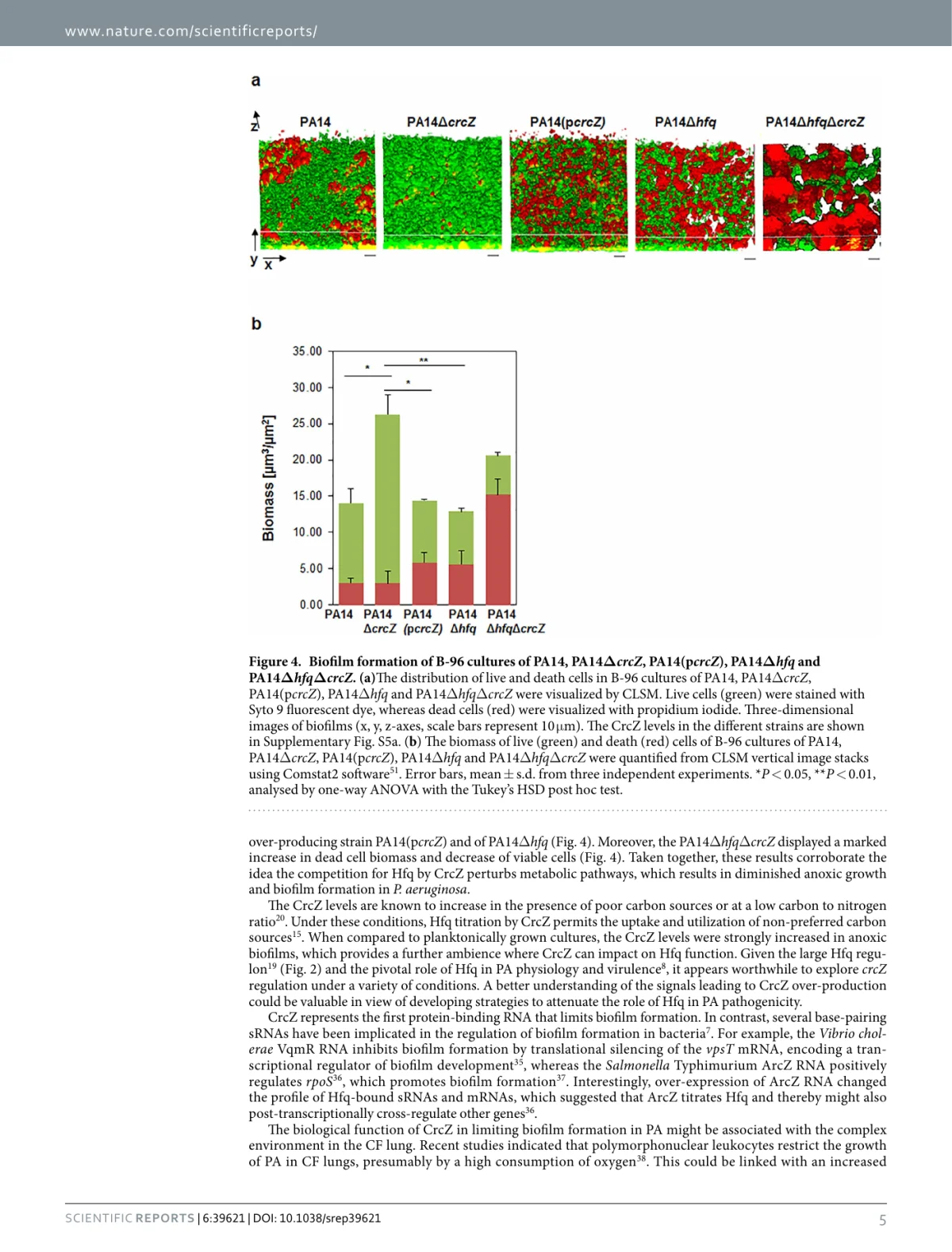
The main biological result is that this is exactly what happens. Deleting crcZ increases anoxic biofilm formation, while overproducing CrcZ reduces it to a level comparable with the hfq deletion mutant. Confocal microscopy and biomass quantification further show that CrcZ levels influence the balance between viable and dead cells in these biofilms. In other words, CrcZ is not just a marker of altered metabolic state. It actively constrains the development of anaerobic biofilms by competing for Hfq.
Methodologically, the study combines RNA-centric and physiology-centric approaches in a useful way. Hfq-bound RNAs were identified by co-immunoprecipitation and RNA-seq, which established the strong enrichment of CrcZ in the bound fraction. This was then followed by targeted analysis of crcZ, hfq, and combined mutant or overexpression strains under anoxic biofilm conditions. The authors also used transcriptome analysis of the hfq mutant and physiological readouts such as metabolic activity, redox balance, crystal-violet assays, and confocal imaging. That range is important because the claim is inherently indirect: CrcZ does not form biofilms itself, it changes the availability of a global RNA chaperone that then alters multiple downstream pathways.
The broader implication is that regulatory decoy RNAs can cross-regulate functions outside the pathways for which they were first discovered. Here, CrcZ couples the nutritional state of the cell to anaerobic biofilm formation by redistributing Hfq. That is a conceptually strong result, because it shows how one abundant RNA can bias the use of a central post-transcriptional regulator toward one physiological program and away from another.
This paper also provides the bridge to several later Pseudomonas studies. The 2018 NAR paper explains at the molecular level how Crc, Hfq, and RNA assemble into repressive complexes during carbon catabolite repression. The 2018 metabolic-sensitization paper uses CrcZ-mediated Hfq sequestration to alter antibiotic susceptibility. The 2020 porin paper then dissects how Hfq and Crc regulate specific antibiotic entry pathways. This 2016 study is where the physiological reach of CrcZ first becomes obvious.
It is also worth noting that the setting here is highly relevant to chronic infection biology. The experiments were done in a medium designed to mimic cystic fibrosis sputum and under oxygen-limited conditions that approximate the microenvironments in established infections. That makes the work more than a basic-regulation paper. It shows that carbon-responsive RNA control is wired into a host-relevant persistence phenotype. Cross-Regulation by CrcZ RNA Controls Anoxic Biofilm Formation in Pseudomonas aeruginosa How Crc modulates Hfq-dependent RNA regulation in Pseudomonas aeruginosa Harnessing Metabolic Regulation to Increase Hfq-Dependent Antibiotic Susceptibility in Pseudomonas aeruginosa PaiI links anaerobic small-RNA regulation to denitrification in Pseudomonas aeruginosaCitation
Petra Pusic, Muralidhar Tata, Michael T. Wolfinger, Elisabeth Sonnleitner, Susanne Haussler, Udo Blasi
Sci. Rep. 6:39621 (2016) | doi:10.1038/srep39621 | PDFSee Also
Elisabeth Sonnleitner, Alexander Wulf, Sebastien Campagne, Xue-Yuan Pei, Michael T. Wolfinger, Giada Forlani, Konstantin Prindl, Laetitia Abdou, Armin Resch, Frederic Allain, Ben Luisi, Henning Urlaub, Udo Blasi
Nucleic Acids Res. 46:1470-1485 (2018) | doi:10.1093/nar/gkx1245 | PDF
Petra Pusic, Elisabeth Sonnleitner, Beatrice Krennmayr, Dorothea Agnes Heitzinger, Michael T. Wolfinger, Armin Resch, Udo Blasi
Front. Microbiol. 9:2709 (2018) | doi:10.3389/fmicb.2018.02709 | PDF
Muralidhar Tata, Fabian Amman, Vinay Pawar, Michael T. Wolfinger, Siegfried Weiss, Susanne Haussler, Udo Blasi
Front. Microbiol. 8:2312 (2017) | doi:10.3389/fmicb.2017.02312 | PDF