This paper asks whether the Hfq/Crc/CrcZ metabolic control system can be used to make Pseudomonas aeruginosa more sensitive to antibiotics, and shows that the answer is yes.
← Back to Blog
Publications
Metabolic control of Hfq-dependent antibiotic susceptibility in Pseudomonas aeruginosa
This paper takes the Hfq story in Pseudomonas aeruginosa one step further. Instead of asking only which genes are controlled by Hfq, it asks whether that regulatory layer can be exploited to make the bacterium more susceptible to antibiotics. That is a more intervention-oriented question, and it gives the work a slightly different flavor from the mechanistic porin paper that followed later. The central idea is that Hfq is not just another global regulator. Because it sits at the intersection of carbon catabolite repression, RNA-mediated control, membrane physiology, and stress adaptation, changing Hfq availability could shift several antibiotic-relevant traits at once.
The starting point is the observation that deletion of hfq increases susceptibility of P. aeruginosa to multiple classes of clinically relevant antibiotics. The paper then asks why that happens and whether the same effect can be reproduced in a less drastic and more physiologically meaningful way. That second question is where CrcZ becomes important. CrcZ is an RNA decoy that sequesters Hfq and thereby counteracts Hfq/Crc-mediated repression. If higher CrcZ levels reduce effective Hfq activity, then metabolic conditions that induce CrcZ, or artificial overexpression of CrcZ, might sensitize cells to antibiotics without deleting a global regulator outright.
Methodologically, the study combines several layers of evidence. It compares antibiotic susceptibility of wild-type and hfq deletion strains in both PAO1 and PA14 backgrounds, uses RNA-seq to identify antibiotic-relevant processes influenced by Hfq, and then ties those transcriptomic changes to physiological phenotypes such as membrane potential, c-di-GMP levels, and biofilm formation. In parallel, the paper tests whether higher CrcZ levels, induced either by plasmid overexpression or by growth on non-preferred carbon sources, can reproduce the sensitizing effect. That combination matters because it turns the paper from a descriptive regulatory study into a proof-of-principle for metabolic re-sensitization.
The result is not a single neat pathway but a broader systems picture. Loss of Hfq affects multiple determinants of antibiotic susceptibility at once, from uptake and efflux functions to membrane-associated traits and energy metabolism. The paper therefore argues that the increased susceptibility of the hfq mutant is a composite phenotype rather than the consequence of one master resistance gene. The biology is messier that way, but it is also more realistic. Antibiotic response in Pseudomonas is usually shaped by overlapping physiological layers rather than by a single switch.
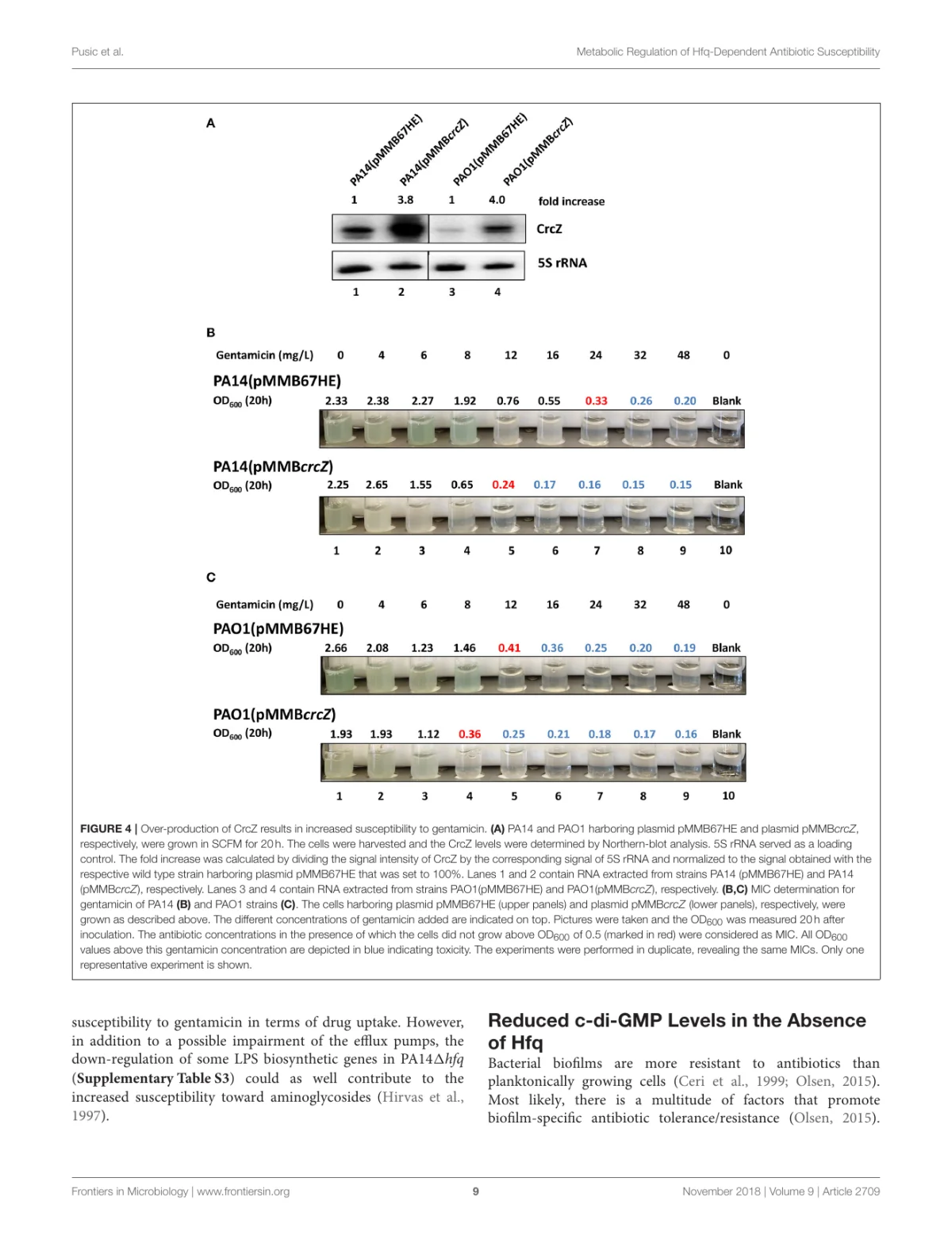
What makes the paper especially interesting is that the CrcZ experiments point toward a controllable lever. Overproducing CrcZ increases sensitivity to gentamicin, and growth on oxaloacetate, a non-preferred carbon source that induces CrcZ, shifts susceptibility in the same direction. In complex synthetic cystic fibrosis sputum medium, adding oxaloacetate also lowers the MIC for gentamicin and cefepime. That gives the paper its practical angle: metabolic context can be used to bias the regulatory state of the bacterium toward a more antibiotic-sensitive phenotype.
The paper is an important bridge to later work on oprD, opdP, Crc, and carbon catabolite repression. It establishes the broader principle that Hfq-dependent post-transcriptional regulation is tied to antibiotic susceptibility in a metabolically responsive way. Later studies dissect individual branches of that logic in more detail. Here, the emphasis stays on the network level, where Hfq availability, modulated by CrcZ, changes how the cell handles drugs across several mechanistic layers.
The paper is also a good example of why bacterial RNA regulation matters beyond classical sRNA target maps. Regulatory RNAs such as CrcZ can have indirect but clinically meaningful effects because they redistribute the activity of central RNA-binding proteins. In this case, a carbon-source-sensitive decoy RNA becomes part of a strategy for shifting susceptibility to aminoglycosides and beta-lactams. That is a strong illustration of how metabolism and antimicrobial response are coupled in opportunistic pathogens. Harnessing Metabolic Regulation to Increase Hfq-Dependent Antibiotic Susceptibility in Pseudomonas aeruginosa Distinctive Regulation of Carbapenem Susceptibility in Pseudomonas aeruginosa by Hfq Rewiring of Gene Expression in Pseudomonas aeruginosa During Diauxic Growth Reveals an Indirect Regulation of the MexGHI-OpmD Efflux Pump by HfqCitation
Petra Pusic, Elisabeth Sonnleitner, Beatrice Krennmayr, Dorothea Agnes Heitzinger, Michael T. Wolfinger, Armin Resch, Udo Blasi
Front. Microbiol. 9:2709 (2018) | doi:10.3389/fmicb.2018.02709 | PDFSee Also
Elisabeth Sonnleitner, Petra Pusic, Michael T. Wolfinger, Udo Blasi
Front. Microbiol. 11:1001 (2020) | doi:10.3389/fmicb.2020.01001 | PDF
Marlena Rozner, Ella Nukarinen, Michael T. Wolfinger, Fabian Amman, Wolfram Weckwerth, Udo Blaesi, Elisabeth Sonnleitner
Front. Microbiol. 13:919539 (2022) | doi:10.3389/fmicb.2022.919539 | PDF